
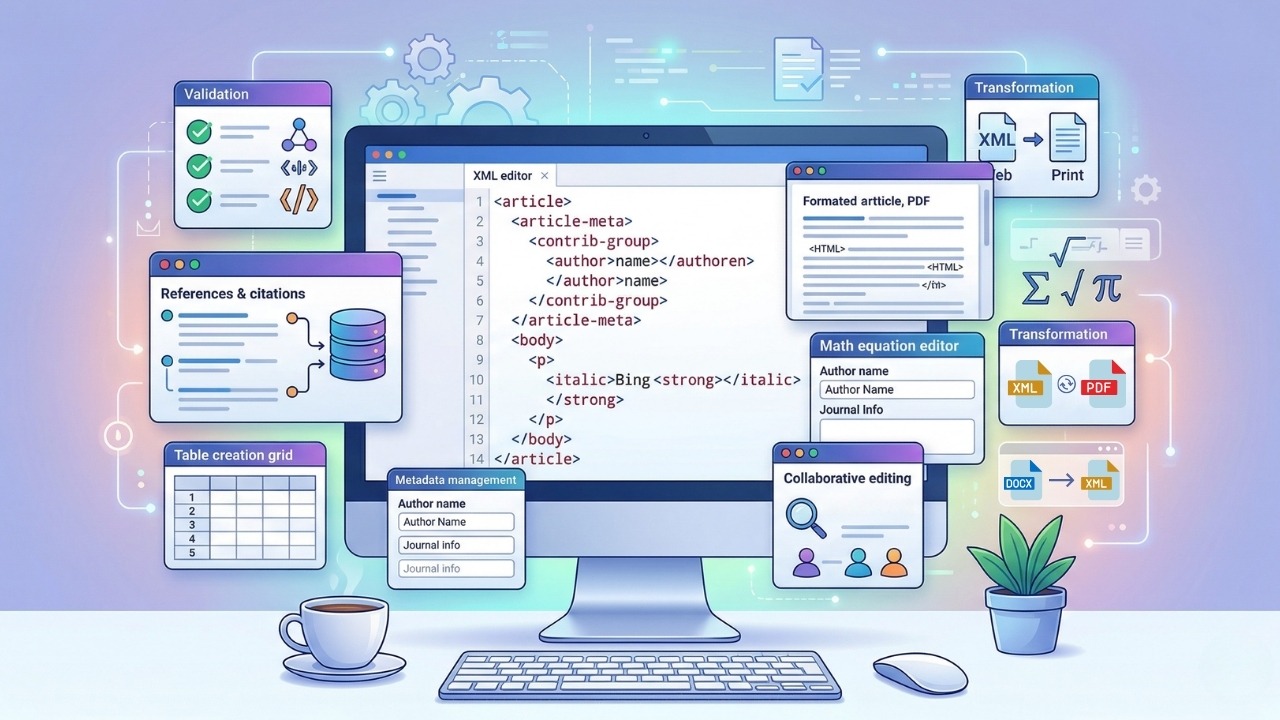
Many users still think that creating JATS XML is simply a process of converting a Word or PDF file into XML. This assumption is completely wrong and often causes major problems in the scientific publishing workflow. JATS XML is not just a technical output format; it is a structured standard designed to represent the full meaning of a scientific article.
In fact, JATS XML contains not only visible content (such as titles and paragraphs) but also important metadata like authors, affiliations, references, funding information, and more. Each tag has a specific function, and incorrect usage or missing elements can cause problems for the entire document. Therefore, creating JATS XML requires more than just conversion; it requires a deep understanding of the standard.
1. The purpose of creating JATS XML must be clearly defined
Before choosing a JATS XML tool, it is important for users to understand the purpose of the XML. There are different technical requirements for each use case; failing to define the purpose from the start often results in incompatible or rejected outputs.
General purposes for creating JATS XML include delivery to indexing platforms, archiving articles in repositories, increasing article visibility in search engines, and standardized metadata in publishing systems. Each of these purposes affects how the XML should be structurally organized, how it should be tagged, and the quality of metadata that is required.
For example, if the goal is indexing, then the XML must comply with the strict structural and tagging rules set by the indexing service. If the goal is visibility, then the XML must focus on well-structured metadata, abstracts, keywords, and structured references. If the goal is not clearly defined, even an XML file that is technically ‘correct’ may fail in practical use.
2. Not all XML is considered “valid” by indexing systems
A misconception is that if an XML file has the correct structure and is error-free, it is ready to be submitted. In fact, the indexing system evaluates XML far beyond basic technical validity.
They evaluate whether the structure complies with their specific requirements, if tags are used correctly, and if all necessary metadata is included, and properly structured. This means an XML file may pass a validator but still be declined by an indexing platform for not complying with its specific requirements.
A good example is PubMed Central, which applies very strict requirements for JATS XML submissions. Anything from a minor error, such as improperly structured references, incomplete author affiliations, or missing declarations, can lead to rejection. So, just because a file is “valid XML” doesn’t automatically mean it’s gonna be accepted.
3. A simple real-world scenario
Consider a journal that wants to submit its articles to an indexing platform such as PubMed Central. The editorial team uses a basic conversion tool to generate a JATS XML file from their manuscript files. The result looks fine, and there are no obvious errors.
However, during the submission process, the XML file is rejected. The rejection includes reasons such as an incomplete <aff> tag for the author’s affiliation, references formatted as plain text rather than structured <element-citation> tags, and missing sections such as funding information or a statement of conflict of interest.
As a result, the team has to revise the XML manually, which often requires extra technical expertise and time. In some cases, they may even need to outsource this correction process. What initially appeared to be a quick fix turns into a costly and time-consuming problem.
4. JATS XML tools cannot be chosen arbitrarily
This leads to a key point: a JATS XML tool is not simply a converter, but a tool that directly impacts if an article can be successfully processed, indexed and searched
Many users make decisions based on speed, price, or simplicity, without evaluating whether the tool meets the standards required by their target platforms. This often results in XML outputs that require extensive manual correction, defeating the purpose of using a tool in the first place.
In reality, even a small tagging mistake can prevent successful indexing. Fixing such issues after XML generation is significantly more expensive—in terms of both time and resources—than selecting a tool that ensures compliance from the beginning.
Before discussing the criteria of a good JATS XML tool, one fundamental principle must be understood: JATS XML is not about converting files, but about preparing articles for interoperability within global publishing systems.
This means the XML must be accurate, complete, and aligned with the requirements of indexing services, repositories, and digital platforms. The tool used plays a crucial role in ensuring that this standard is consistently met.
With this understanding, the next step is to evaluate what defines a reliable and effective JATS XML tool—based not on convenience, but on its ability to produce compliant, high-quality XML outputs.
1. Compliance with JATS Standards
A reliable JATS XML tool must fully comply with official JATS standards such as Publishing or Archiving DTD. This means the structure, hierarchy, and tag usage strictly follow what is defined in the schema. Without this compliance, the XML may look correct but fail validation when checked against official systems.
For example, a correct structure for an article title should be:
<article-title>Impact of AI on Scholarly Publishing</article-title>A poorly generated XML might incorrectly wrap this inside a generic <p> tag, which is technically valid XML but semantically wrong in JATS.
A common issue in low-quality tools is mixing or misplacing tags. For instance, placing <abstract> outside <front> or misusing <sec> inside metadata sections. These mistakes often pass unnoticed until submission.
Platforms like PubMed Central enforce strict compliance. Even a small deviation from their expected DTD can lead to rejection, forcing users to manually fix structural errors.
Users often report frustration when their XML “passes internal checks” but fails external validation. This usually indicates that the tool does not truly enforce JATS compliance but only ensures basic XML syntax correctness.
2. Complete and Structured Metadata
A good JATS XML tool must ensure that all essential metadata is captured and structured properly. This includes authors, affiliations, abstracts, keywords, references, funding, and declarations.
For example, a correct author structure:
<contrib contrib-type="author">
  <name>
    <surname>Smith</surname>
    <given-names>John</given-names>
  </name>
  <aff>University of Example</aff>
</contrib>
A poor tool might output:
<author>John Smith, University of Example</author>This loses semantic meaning and breaks indexing compatibility.
Many users underestimate how critical structured metadata is. Indexing systems rely on these tags to extract and display information correctly. Missing <aff> or <contrib-id contrib-id-type="orcid"> can reduce credibility and discoverability.
A real issue occurs when references are not structured. Instead of:
<element-citation>
some tools output plain text references, making them unusable for citation indexing.
This leads to extra manual work, where editors must reconstruct metadata that should have been captured automatically.
3. User-Friendly Interface (Non-Technical Usability)
Most users of JATS tools are editors, not developers. Their primary responsibility is ensuring the accuracy and quality of academic content, not managing the syntactic requirements of a markup language. Therefore, the tool must provide a form-based interface instead of requiring users to edit raw XML.
For example, instead of asking users to write:
<kwd-group>
  <kwd>AI</kwd>
  <kwd>machine learning</kwd>
</kwd-group>
The tool should provide a simple input field labeled “Keywords” where values are entered as plain text, separated by commas or line breaks. The tool then handles all XML generation automatically in the background.
This distinction is not trivial. Raw XML editing introduces several categories of risk that are particularly damaging in editorial workflows. First, structural errors such as unclosed tags, incorrect nesting, or misplaced attributes can invalidate the entire document at the schema validation stage, requiring significant time to diagnose and correct. Second, editors working under deadline pressure are prone to accidental deletions, especially when navigating large XML files in a plain-text editor without syntax highlighting or real-time validation. Third, JATS itself is a complex schema with over 600 elements, many of which carry contextual rules governing where and how they may appear. No non-specialist can be expected to internalize these rules without extensive training.
4. Automation and Workflow Efficiency
An effective JATS tool must reduce manual effort through automation at every stage of the editorial production pipeline. This includes importing content from common source formats such as DOCX, integrating with existing journal management systems, and supporting bulk processing across multiple articles simultaneously.
The most immediate automation requirement is the extraction of structured content from Word documents. Academic authors almost universally submit manuscripts in DOCX format. Rather than requiring editors to retype or manually map content into JATS fields, the tool should parse the Word file and extract structured elements. For example headings mapped to <sec> and <title>, body paragraphs to <p>, reference lists to <ref-list>, tables to <table-wrap>, and figures to <fig> based on the document’s underlying style information.
A weak implementation of this extraction process treats the DOCX as a flat stream of text. Everything becomes a tag. Heading levels are lost. Reference entries are not individually parsed into their component fields author, year, title, source, DOI. Tables may be collapsed into comma-separated text or omitted entirely. The output is technically a valid XML file in the syntactic sense, but semantically it is no more useful than the original plain text. Editors receiving this output must then manually identify each structural element, wrap it in the correct JATS tag, and populate attributes by hand a process that in many cases takes longer than starting from scratch.
5. Clear Validation and Error Feedback
Validation is not just about detecting errors, it is about explaining them clearly. A good tool must provide actionable feedback.
For example, instead of showing a vague message like:
Error: invalid element
it should point directly to the problem:
Error: <aff> is missing inside <contrib> at line 47 — author affiliation is required by PMC schema.
Many tools fail here by producing generic or overly technical error messages, leaving users confused about what actually went wrong and how to fix it.
What good validation looks like:
- It tells you what is wrong (
<aff>is missing) - It tells you where it is wrong (inside
<contrib>, line 47) - It tells you why it matters (author affiliation is required)
- Ideally, it tells you how to fix it (add
<aff>as a child of<contrib>)
Clear, structured validation feedback reduces dependency on technical experts, speeds up the correction process, and makes XML authoring tools accessible to a wider range of users — not just those with deep schema knowledge.
6. Compatibility with Publishing Ecosystems
A JATS XML tool does not operate in isolation. It exists within a broader publishing infrastructure that spans manuscript submission, peer review management, editorial production, metadata registration, and indexing. For a tool to deliver practical value, it must integrate or align with the systems, formats, and workflows that already govern these stages. For example, Open Journal Systems, which remains the dominant platform for academic journal management particularly in developing regions and institutional publishing contexts.
Some tools fail because they are too isolated. They generate XML that cannot be easily used in real workflows.
Users then need additional steps or tools to bridge the gap, increasing complexity. Compatibility ensures smooth transitions between submission, editing, XML generation, and indexing.
7. Customizability for Different Requirements
Academic publishing does not operate under a single uniform standard. While JATS provides a shared foundational schema, the specific tagging requirements imposed by different indexing platforms vary considerably. A tool that enforces one fixed output structure will satisfy some workflows completely while failing others in ways that require manual intervention to resolve negating much of the tool’s utility.
The variation extends beyond metadata into document structure. A medical journal submitting to PubMed Central operates under a substantially different tagging profile than a Latin American journal depositing to SciELO, which in turn differs from a social sciences journal submitting records to EBSCO. Rigidly structured tools assume that one platform’s requirements represent all platforms’ requirements, which is accurate for none of them.
8. Consistency and Reliability
A JATS XML tool must produce structurally identical output for structurally identical input, without variation introduced by differences in input formatting, session state, or processing order. Inconsistency in output structure is not a minor inconvenience, it is a systematic failure that propagates through every downstream process that depends on the XML. When one article encodes section hierarchy using correctly nested elements while another produced by the same tool flattens all sections to a single depth because the source document used inconsistent heading styles, the resulting archive is non-uniform. Indexing systems that traverse section structure to extract structured full-text encounter different document shapes and either silently misclassify content or reject files outright. Rendering systems that generate HTML or PDF from JATS produce visually inconsistent output across issues. Reference linking systems that depend on predictable element structure fail on articles where the tool’s reference parser produced a different output pattern due to minor formatting variations in the source file.
The specific failure mode most commonly reported is input-dependent output variation. A tool that parses DOCX source files and maps heading styles to JATS section elements will produce correct output for manuscripts that use Word’s built-in Heading styles, but will produce undifferentiated elements for manuscripts where authors manually bolded and enlarged text to simulate headings without applying style tags. Both inputs are visually identical to a human reader. The tool treats them as structurally different and produces different XML, despite the editor’s reasonable expectation that the same content produces the same output. Reliable tools handle this through normalization, detecting common heading patterns through heuristic analysis when formal style information is absent, and flagging ambiguous cases for editor review rather than silently producing degraded output.
9. Documentation and Support
A JATS XML tool may be technically capable across every dimension structured extraction, multi-platform export, configurable profiles, consistent output and still fail in deployment if users cannot determine how to operate it correctly. Documentation is not supplementary material produced after development is complete. It is a functional component of the tool that determines whether its capabilities are accessible to the editorial staff who must use it under real working conditions. The target users of JATS tools are journal editors and production staff, not XML specialists. Documentation written with that audience in mind covers not only what each feature does but why specific tagging decisions matter, what downstream consequences follow from incorrect usage, and how to recognize when output requires review. A user encountering a reference tagging problem should be able to locate a guide that explains the distinction between <element-citation> and <mixed-citation>, illustrates correct attribute usage for different publication types, and identifies the validation errors that result from common mistakes without needing to consult the JATS specification directly or escalate to technical support for every routine issue.
The specific failure mode most commonly reported is input-dependent output variation. A tool that parses DOCX source files and maps heading styles to JATS section elements will produce correct output for manuscripts that use Word’s built-in Heading styles, but will produce undifferentiated elements for manuscripts where authors manually bolded and enlarged text to simulate headings without applying style tags. Both inputs are visually identical to a human reader. The tool treats them as structurally different and produces different XML, despite the editor’s reasonable expectation that the same content produces the same output. Reliable tools handle this through normalization, detecting common heading patterns through heuristic analysis when formal style information is absent, and flagging ambiguous cases for editor review rather than silently producing degraded output.
10. Scalability for Growing Needs
Finally, the tool must scale with the user’s needs. This includes handling multiple journals, large volumes of articles, and multiple users. For example, a publisher managing 10 journals cannot rely on a tool designed for single-article processing. Features like user roles, batch processing, and project management become essential.
A non-scalable tool may work initially but becomes inefficient as workload increases. Users often outgrow simple tools and are forced to migrate, which can be costly.
Scalability ensures long-term usability and supports business growth without requiring frequent tool changes.
Conclusion
Choosing a JATS XML editor is not purely a technical decision. It is a strategic one with direct consequences for article acceptance rates at indexing platforms, editorial team efficiency, and the long-term operational sustainability of the journal.
The ten criteria outlined in this article standards compliance, structured metadata, user-friendly interface, workflow automation, validation, ecosystem compatibility, customizability, consistency, documentation, and scalability form a complete evaluation framework. Overlooking any single criterion does not eliminate the problem it addresses. It defers that problem until publication volume increases or until a target indexing platform tightens its submission requirements, at which point the cost of correction is substantially higher than it would have been at the tool selection stage.
The right JATS XML tool is not the cheapest option or the one with the most prominent feature list. It is the one that reliably produces compliant XML, meaningfully reduces manual workload, and remains viable as the journal’s needs grow over time. Evaluation should be conducted using real articles and actual submission scenarios against the journal’s target platforms not vendor demonstrations using controlled sample files that do not reflect the structural irregularities present in real manuscript submissions.
Well-produced JATS XML is ultimately what connects a journal’s content to global visibility, cross-platform interoperability, and the indexing credentials that determine academic credibility. Investing in the correct tool from the beginning avoids the compounding costs in time, budget, and operational disruption that follow from selecting an inadequate one and migrating away from it after the journal has already scaled.
For publishers and journal managers evaluating their current production workflow, the gap between where XML quality stands today and where indexing platforms require it to be is rarely closed by incremental manual effort. It is closed by adopting tooling built specifically to meet those requirements without placing the technical burden on editorial staff.
JATS Editor is built around exactly these ten criteria from structured metadata and multi-platform export profiles to role-based access and batch processing. It handles the XML layer so editorial teams can focus entirely on content quality and publication timelines.
Explore JATS Editor and see how it fits your journal’s production workflow at jatseditor.com