
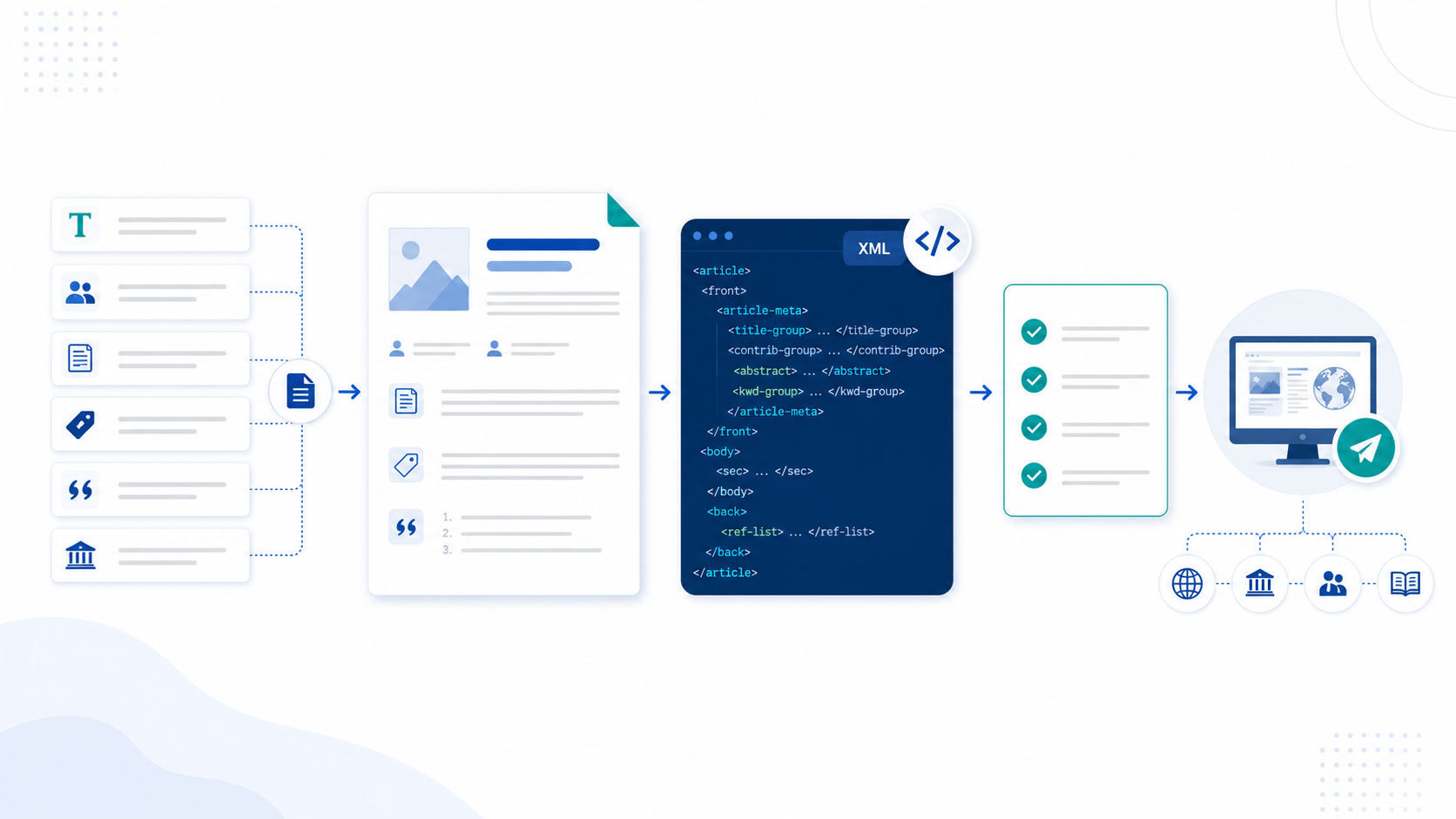
SciELO is not just another indexing database. It is a structured publishing ecosystem with its own XML standard, its own validation pipeline, and its own rules that override, and frequently conflict with, what authors and editors assume they know about JATS XML. Publishers who treat SciELO as “just upload your article” discover the gap the hard way, through rejection notices and resubmission cycles. Understanding what SciELO actually requires, and why it requires it, closes that gap before it costs time.
What Is the SciELO Publishing Schema?
The SciELO Publishing Schema (SPS) is an XML specification based on JATS. JATS provides a broad vocabulary for representing scholarly articles, while SPS defines how that vocabulary must be used within the SciELO workflow.
JATS is intentionally flexible because it supports many publishers, platforms, disciplines, and production systems. SciELO needs more consistent input. Its processing pipeline must identify article metadata, render full text, connect citations, and distribute structured information to other services.
SPS therefore acts as a constrained JATS profile. It can:
- Require elements that generic JATS treats as optional;
- Limit accepted attribute values;
- Define specific structures for metadata;
- Enforce relationships between identifiers and article components;
- Apply business rules beyond basic Document Type Definition (DTD) validation.
This is the central difference in any SciELO vs JATS comparison. JATS provides the vocabulary. SPS defines the rules required for the SciELO publishing environment.
Why SciELO JATS XML Requirements Are More Specific
SciELO processes articles as structured data, not only as documents for human reading. Consistent XML helps the platform display content and reuse metadata without manually interpreting every submission.
The requirements support several operational needs:
- identifying authors and their institutions;
- representing titles, abstracts, and keywords in multiple languages;
- connecting articles to journal, issue, DOI, and publication identifiers;
- rendering tables, figures, and mathematical expressions;
- exposing license and funding information;
- processing references for citation linking;
- validating packages before publication.
Loose or incomplete tagging makes these tasks unreliable. SPS reduces ambiguity by requiring predictable structures.
SciELO Publishing Schema Version and Article Declaration
Publishers must prepare XML against the SPS version accepted by the relevant SciELO collection. Schema versions can change, and a local collection may provide transition instructions or additional submission guidance.
Do not assume that an old template remains valid. Before production, verify:
- the SPS version accepted by the destination collection;
- the required root article attributes and namespaces;
- the permitted
article-typevalues; - the current validation and package requirements;
- any collection-specific editorial rules.
The root <article> element identifies the document as a JATS article and provides information used during validation. A mismatch between the declared schema context and the XML structure can produce errors before the article reaches editorial review.
SciELO Journal and Article Metadata Requirements
The <front> section contains the metadata that identifies the journal and article. Within it, <journal-meta> describes the journal, while <article-meta> describes the individual publication.
Journal metadata may include:
- journal identifiers;
- full and abbreviated journal titles;
- print and electronic ISSNs, when applicable;
- publisher information.
Article metadata may include:
- DOI and other article identifiers;
- article categories;
- title and translated title groups;
- contributors;
- affiliations;
- abstract and translated abstracts;
- keywords;
- publication dates;
- volume, issue, and pagination or electronic location;
- permissions and license information;
- article history;
- funding data.
Publishers should not invent a SciELO identifier. Identifier handling must follow the destination collection’s workflow. Existing identifiers should be preserved accurately, while identifiers assigned by SciELO should be managed according to its submission process.
SciELO Structured Affiliations and ORCID
Affiliations must be tagged so systems can distinguish an institution from its divisions, location, and country. A plain sentence may be readable to a person but difficult to process consistently.
A structured affiliation can separate:
- the main institution;
- faculty, school, or department;
- city and region;
- country;
- institutional identifiers, when supported;
- author contact information, when required.
Each contributor must link to the correct affiliation through stable XML identifiers. These links should be checked carefully when several authors share institutions or when one author has multiple affiliations.
ORCID values should follow the format required by the applicable SPS documentation. Use a complete, valid identifier and associate it with the correct contributor. Do not add an ORCID based on name matching alone.
SciELO Open Access License and Funding Information
SciELO articles need machine-readable permissions and license data. The <permissions> structure should identify the license and provide its link or text as required by the relevant specification.
The license in the XML must match the license displayed by the journal. Editors should verify the Creative Commons version and conditions rather than inserting a default value.
Funding information also benefits from structured tagging. Use <funding-group> and related JATS elements when required to distinguish:
- the funding organization;
- award or grant number;
- recipient;
- funder identifier, when available.
Structured funding data is more useful than leaving the entire statement only as prose in the acknowledgments.
SciELO MathML Equations and LaTeX Workflows
Mathematical content requires special attention because LaTeX source and publication XML serve different purposes. Authors may write equations in LaTeX, but the delivery workflow must represent them in the form required by SciELO.
JATS provides <inline-formula> for equations within a paragraph and <disp-formula> for displayed equations. MathML can be embedded within these elements to preserve mathematical structure.
Before submission, verify:
- inline and displayed formulas use the correct containers;
- equation labels and cross-references resolve correctly;
- MathML namespaces are declared;
- symbols render correctly;
- the XML does not depend only on an image when accessible math is required;
- converted formulas preserve the meaning of the LaTeX source.
LaTeX-to-MathML conversion should be followed by visual and semantic checking. Automated conversion can misinterpret macros, alignment, or uncommon notation.
Structured References for SciELO Submission
Each bibliographic reference should be represented as an individual <ref> item. Whenever possible, its components should be tagged separately inside an appropriate citation element.
Useful components include:
- authors or editors;
- article or chapter title;
- source title;
- publication year;
- volume and issue;
- page range or electronic location;
- DOI, PMID, or another persistent identifier;
- publisher and publication location for books.
Structured references help citation linking and metadata reuse. They also make it easier to detect incomplete citations before publication. Every in-text citation should point to an existing reference ID, and every reference should be reviewed for unresolved or duplicate links.
SPS Validation With Packtools
DTD validation checks whether XML follows the declared structural grammar. It does not necessarily cover every SciELO business rule. SPS validation is therefore a separate production step.
Packtools is part of the SciELO XML processing ecosystem and can help inspect article packages against applicable rules. A reliable validation workflow should:
- confirm that the XML is well formed;
- validate it against the required schema or DTD;
- run the applicable SPS checks;
- inspect errors and warnings;
- verify figures, tables, equations, links, and supplementary files;
- repeat validation after every correction.
Do not treat a clean generic JATS validation result as proof that the package is ready for SciELO.
Conclusion
SciELO Publishing Schema is best understood as a controlled implementation of JATS for a specific publishing network. Its requirements make article content predictable enough for validation, rendering, metadata exchange, and long-term reuse.
Publishers should begin with the accepted SPS version, structure metadata carefully, convert mathematical content correctly, and validate the complete package before submission. This approach reduces correction cycles and produces XML that is more useful across PubMed, Scopus, DOAJ, and EBSCO.