
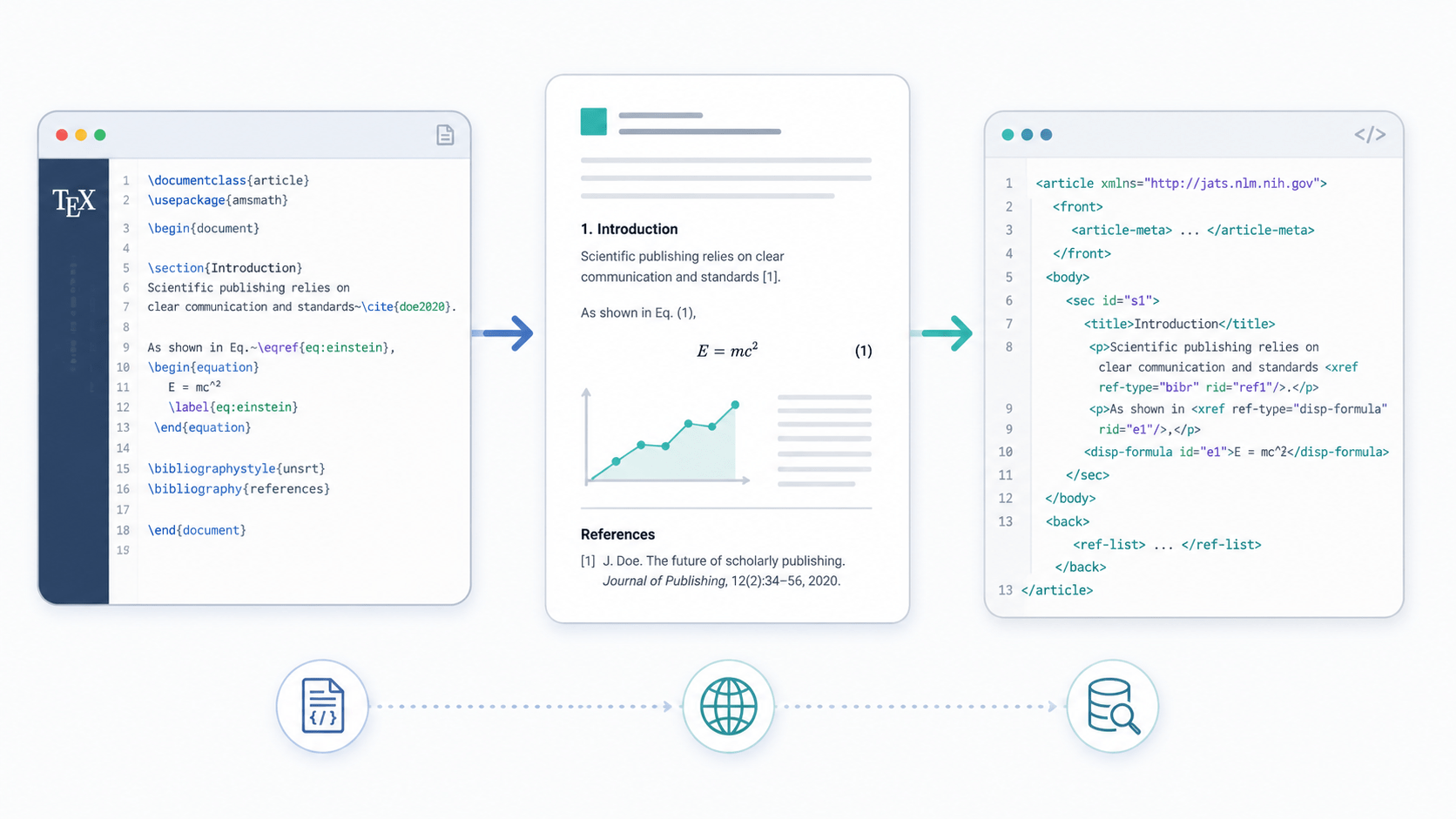
LaTeX has been the backbone of scientific writing for over 40 years. Created by Leslie Lamport in 1984 as a set of macros on top of Donald Knuth’s TeX typesetting system, LaTeX now powers research writing across every STEM discipline. arXiv hosts over 3.1 million preprints, with 19,000 to 32,000 new submissions each month throughout 2025 and 2026. The vast majority of physics, mathematics, and computer science papers on the platform are written in LaTeX. Overleaf, the cloud-based LaTeX editor, reports more than 20 million users across 189 countries who have created over 100 million documents.
But here is where things get complicated. When a journal needs to get its articles into indexing systems and full-text archives, LaTeX hits a wall. Converting a paper from LaTeX to a structured format that indexing platforms and archives can process is not a one-click operation. PubMed Central (PMC) recommends JATS (Journal Article Tag Suite) XML for full-text deposits. DOAJ accepts its own native XML and Crossref XML for metadata. None of these platforms accept LaTeX source files as a final deposit format.
This article explains LaTeX in scientific publishing, what LaTeX is great at, where JATS XML fits into the picture, what different platforms actually require, and how journals can bridge the gap between authoring in LaTeX and submitting structured XML.
1. LaTeX as an Authoring and Typesetting Tool
Understanding why LaTeX dominates scientific writing starts with what it was designed to do: produce publication-quality typeset output, especially for mathematics.
1.1. Content and Presentation Separation
LaTeX embraces a philosophy of separating content from visual formatting. You write \section{Introduction} and LaTeX handles numbering, spacing, and font selection. You write \begin{figure} and LaTeX places it according to publisher-specified rules. This approach mirrors how CSS separates styling from HTML structure, but applied to print documents.
1.2. Mathematics Typesetting
Donald Knuth created TeX in 1978 specifically to typeset mathematics beautifully. LaTeX built on this foundation. Syntax like \frac{a}{b}, \sum_{i=1}^{n}, and \int_{0}^{\infty} lets researchers write complex equations quickly and receive sharp, professionally-typeset output. The LaTeX Project continues to develop and maintain this capability, with the most recent release on June 1, 2026.
1.3. Reference Management
With BibTeX or BibLaTeX, researchers maintain a separate .bib file of all their references. LaTeX formats citations and bibliographies to match the target journal’s style. Switching from one journal’s style to another often means changing a single configuration line, though the exact mechanism differs between classic BibTeX (\bibliographystyle{}) and the more modern BibLaTeX package. For papers with 50 or more references, this automation saves significant time.
1.4. Free, Open Source, and Cross-Platform
LaTeX is distributed under the LaTeX Project Public License (LPPL). Distributions like TeX Live (cross-platform) and MiKTeX (Windows) are free to download and use. No license fees, no subscriptions. This accessibility matters for researchers at institutions with limited budgets worldwide.
1.5. Massive Journal Template Ecosystem
CTAN (Comprehensive TeX Archive Network) hosts thousands of packages and official journal templates. Major publishers including Elsevier, Springer, IEEE, ACM, and Cambridge University Press provide LaTeX templates for manuscript submission. Overleaf’s template gallery lets researchers start writing immediately without installing anything locally.
2. Where LaTeX is Used in Academic Work
LaTeX serves a broad range of academic document types:
- Papers and preprints.
arXiv (physics, mathematics, computer science, over 3.1 million total submissions) and bioRxiv (biology) accept LaTeX submissions natively. - Theses and dissertations.
Top universities including MIT, Stanford, Cambridge, and ETH Zurich provide official LaTeX templates for graduate students. - Scientific books and textbooks.
Springer, Elsevier, Cambridge University Press, and Oxford University Press accept LaTeX manuscripts. Many standard STEM textbooks are written directly in LaTeX. - Presentation slides.
The Beamer package lets researchers create presentation slides from the same source files as their papers, eliminating duplicated work. - Conference posters.
Packages liketikzposterandbaposterproduce professional scientific posters from LaTeX source. - Academic CVs.
LaTeX CV templates likemoderncvhave become a de facto standard in academia.
4. JATS XML as an Article Exchange Model
JATS (Journal Article Tag Suite) is ANSI/NISO Z39.96-2024, a formal standard for tagging journal articles in XML. Unlike LaTeX, which is designed for typesetting a single output (PDF), JATS is designed for data exchange: a single XML file can be transformed into HTML, PDF, ePUB, or mobile views. JATS defines three article models (Archiving, Publishing, and Authoring) with different levels of tag permissiveness.
What makes JATS different from LaTeX is its semantic richness. A LaTeX document uses \author{Name} and \affiliation{Department}. A JATS document uses structured elements like <contrib contrib-type="author">, <contrib-id contrib-id-type="orcid">, <aff>, <institution-wrap>, and <institution-id institution-id-type="ror">. Machines can read these elements, extract metadata, and route articles to the right indexing services.
The key insight: LaTeX and JATS serve different purposes. LaTeX is an authoring and typesetting system. JATS is an article exchange and preservation format. Neither fully replaces the other. The analogy often used is that LaTeX asks “how should this page look?” while JATS asks “what does each part of this article mean?” This is a simplification, but it captures the fundamental difference in design philosophy.
5. What Different Platforms Actually Require
This is where the most common misconception lives: not every indexing platform requires JATS XML, and even those that use JATS have different profiles and rules.
PubMed Central (PMC)
PMC is a full-text archive of biomedical and life sciences literature with over 10 million articles. PMC recommends JATS XML for full-text deposits and provides a StyleChecker to validate files. However, PMC’s File Submission Specifications allow other DTDs with prior approval. LaTeX source files are not accepted as a final deposit format, but PMC works with publishers and deposit pathways, not individual researchers submitting LaTeX manuscripts directly.
DOAJ
The Directory of Open Access Journals indexes metadata, not full-text articles. For article metadata uploads, DOAJ accepts DOAJ Native XML or Crossref XML. DOAJ does not require JATS XML. Full-text availability is verified through a URL, not a direct XML deposit.
Scopus and Web of Science
Scopus and Web of Science are abstracting and indexing databases. They index article metadata (title, authors, abstract, references) delivered through agreements with publishers. Neither platform requires journals to submit full-text JATS XML for every article to be indexed. Publishers work with these services through established data feeds that follow the platform’s own specifications.
Crossref
Crossref is a DOI registration agency, not a full-text index. It accepts metadata deposits using its own schema, not JATS XML.
Note: JATS XML improves interoperability across many platforms that handle full-text articles, but it is not a universal requirement. Each platform has its own specifications. Journals need to understand the specific format, profile, and validation rules for each target.
6. LaTeX and JATS XML: Where They Diverge
| Aspect | LaTeX | JATS XML |
|---|---|---|
| Primary purpose | Typesetting: producing high-quality PDF output | Data exchange: machine-readable article structure |
| Standard | De facto community standard, LPPL license | ANSI/NISO Z39.96-2024 formal standard |
| Outputs | PDF, DVI; HTML via converters | HTML, PDF, ePUB, mobile views via XSLT |
| Semantic structure | Logical structure via macros and classes (section, figure); output influenced by class design | Explicit semantic elements: <contrib-group>, <aff>, <fn-group>, <permissions> |
| Author metadata | Manual, unstructured | Structured: <contrib-id contrib-id-type="orcid">, affiliation with institution identifiers |
| Article metadata | Scattered across preamble | Centralized in <front>/<article-meta>: DOI, history dates, volume, issue, page range, copyright, license |
| References | Separate .bib file, formatted at compile time | <ref-list> integrated in XML, each reference with <pub-id> for DOI or PMID |
| Mathematics | Native TeX math typesetting engine | <tex-math> wrapper for LaTeX notation, <mml:math> for MathML, or images; actual rendering depends on the downstream processor |
| Images | \includegraphics with print positioning | <graphic xlink:href="..."> with mimetype and optional alt-text |
| Licensing | Manual text in the document | <permissions> block with structured <license> (CC BY, etc.) |
| Data availability | No standard approach | <sec sec-type="data-availability"> for structured statements |
| Conversion to web | LaTeX2HTML, pandoc (often requires manual fixes) | Native HTML/ePUB via XSLT transformation |
The comparison is not “LaTeX versus JATS.” They occupy different stages of the publishing pipeline. LaTeX is written by researchers. JATS is produced by publishers, production teams, or conversion tools. The challenge is moving from one to the other accurately and efficiently.
7. Mathematics in JATS XML
Since mathematics is LaTeX’s strongest domain, understanding how formulas transfer between LaTeX and JATS XML is important for STEM journals.
JATS can represent mathematical formulas through several mechanisms:
<tex-math>: Wraps LaTeX math notation within<inline-formula>(for in-text formulas) or<disp-formula>(for display formulas). This is a notation wrapper, not a typesetting engine. Whether the LaTeX inside<tex-math>renders correctly depends on the downstream processor.<mml:math>: Wraps MathML markup, the W3C standard for mathematical notation on the web. MathML is more machine-readable than TeX notation but harder to author manually.- Images: Formulas can be provided as images, though this is the least desirable approach for accessibility, search, and reuse.
For journals converting LaTeX papers to JATS XML, the formula pathway matters. LaTeX math notation inside <tex-math> preserves the author’s original syntax but requires a MathML-aware renderer or TeX engine downstream to produce readable output. Some platforms accept MathML instead, which some conversion tools can generate from LaTeX source.
8. Converting from LaTeX to JATS XML
The reality of modern scientific publishing creates a multi-stage workflow. Researchers write in LaTeX. Journals receive the manuscript. Somewhere in the production process, the article needs structured XML if the journal targets platforms that require or benefit from it, such as PMC.
Conversion Approaches
- Pandoc.
Pandoc (pandoc -f latex -t jats) is free and open source. It handles straightforward documents reasonably well. Complex LaTeX with custom commands, intricate tables, or non-standard packages often produces output that requires manual cleanup to pass JATS validation.
- Dedicated conversion tools.
Tools like JATS Editor provide visual editing and JATS XML export with built-in validation. They support LaTeX formula notation inside a rich text environment, allowing researchers to use familiar math syntax while producing structured XML output.
- Manual conversion.
For journals with in-house XML expertise, manual conversion gives the most control but requires deep knowledge of JATS tagging conventions and the target platform’s specific profile.
Limitations of Automation
No automated LaTeX-to-JATS converter handles every edge case perfectly. Custom LaTeX macros, complicated table structures, and non-standard bibliography styles can all cause conversion errors. Validation against the target platform’s requirements (such as the PMC StyleChecker) is essential regardless of the conversion method used.
9. Advantages and Limitations
What LaTeX Excels At
- Mathematics typesetting.
LaTeX produces clean, professional mathematical notation that has been the gold standard in STEM publishing for decades.
- Template ecosystem.
Thousands of journal-specific templates on CTAN and Overleaf let researchers start writing immediately.
- Cloud collaboration.
Overleaf provides real-time collaborative editing, track changes, and direct submission to journals and preprint servers.
- Build reproducibility.
When source files, the TeX distribution, and all dependencies are locked together in a controlled environment, LaTeX output can be consistently reproduced across builds.
- Free and open.
No license fees, no vendor lock-in. Supported by the TeX Users Group and community donations.
Where LaTeX Falls Short
- Not a final deposit format for archives or indexes.
PMC and similar platforms require structured XML, not LaTeX source. LaTeX is an authoring format. It needs an additional step to become a machine-readable exchange format.
- Limited structured metadata.
Author identifiers (ORCID), affiliation identifiers (ROR), funding statements, and license information in LaTeX documents are typically free text. They are not structured in a way that indexing systems can automatically extract and process.
- Challenging web conversion.
Converting LaTeX to HTML with full fidelity for complex documents remains difficult. Tools likelatex2htmlandpandocoften require manual post-processing.
- Steep error messages.
LaTeX error messages like “Undefined control sequence” can be cryptic for new users, often without clear pointers to the exact location of the problem.
What JATS XML Enables
- Platform-ready structured content.
JATS XML can be validated against platform-specific schemas before submission, reducing rejection risk.
- Machine-readable metadata.
Author ORCIDs, affiliation ROR IDs, funding statements, license types, and data availability are all structured in semantically meaningful XML elements that indexing systems and aggregators can process.
- Multi-format output.
One JATS XML file can be transformed into HTML, PDF, ePUB, or mobile views through XSLT processing.
- Structure that supports accessibility.
JATS provides elements like<alt-text>for images and semantic heading levels. When combined with proper tagging practices and compatible rendering, these structures help produce accessible outputs.
Where JATS XML Requires Effort
- Complexity.
JATS defines a large element set. Manual authoring requires understanding XML, DTD rules, and the target platform’s profile.
- Not a typesetting engine.
JATS is a data format. Producing publication-quality PDF from JATS requires additional processing through XSL-FO or other rendering pipelines.
- Tool dependency.
Creating valid JATS XML without a specialized editor is technically demanding and time-consuming for teams without XML expertise.
Conclusion
LaTeX and JATS XML solve different parts of the same publishing workflow. Researchers use LaTeX to write formula-rich manuscripts, while publishers use JATS XML to structure, exchange, and preserve article content.
Moving between these formats is still difficult. Custom commands, references, tables, figures, and equations can lose structure during conversion, so journal teams often need to review and correct the resulting files manually.
JATS Editor is being developed to make this workflow easier. Upcoming LaTeX support is planned to include both import and export capabilities, creating a more direct bridge between LaTeX manuscripts and structured JATS XML. With LaTeX import, users will be able to bring .tex manuscripts into JATS Editor for structured editing and conversion. The goal is to preserve core content, metadata, references, and mathematical expressions wherever possible. With LaTeX export, users will be able to generate .tex output from structured article content. This will support workflows that still require LaTeX for collaboration, journal templates, typesetting, or downstream production.
In the meantime, JATS Editor provides a visual environment for creating and editing structured JATS XML. Try the JATS Editor and follow product updates for the upcoming LaTeX import and export workflow.